
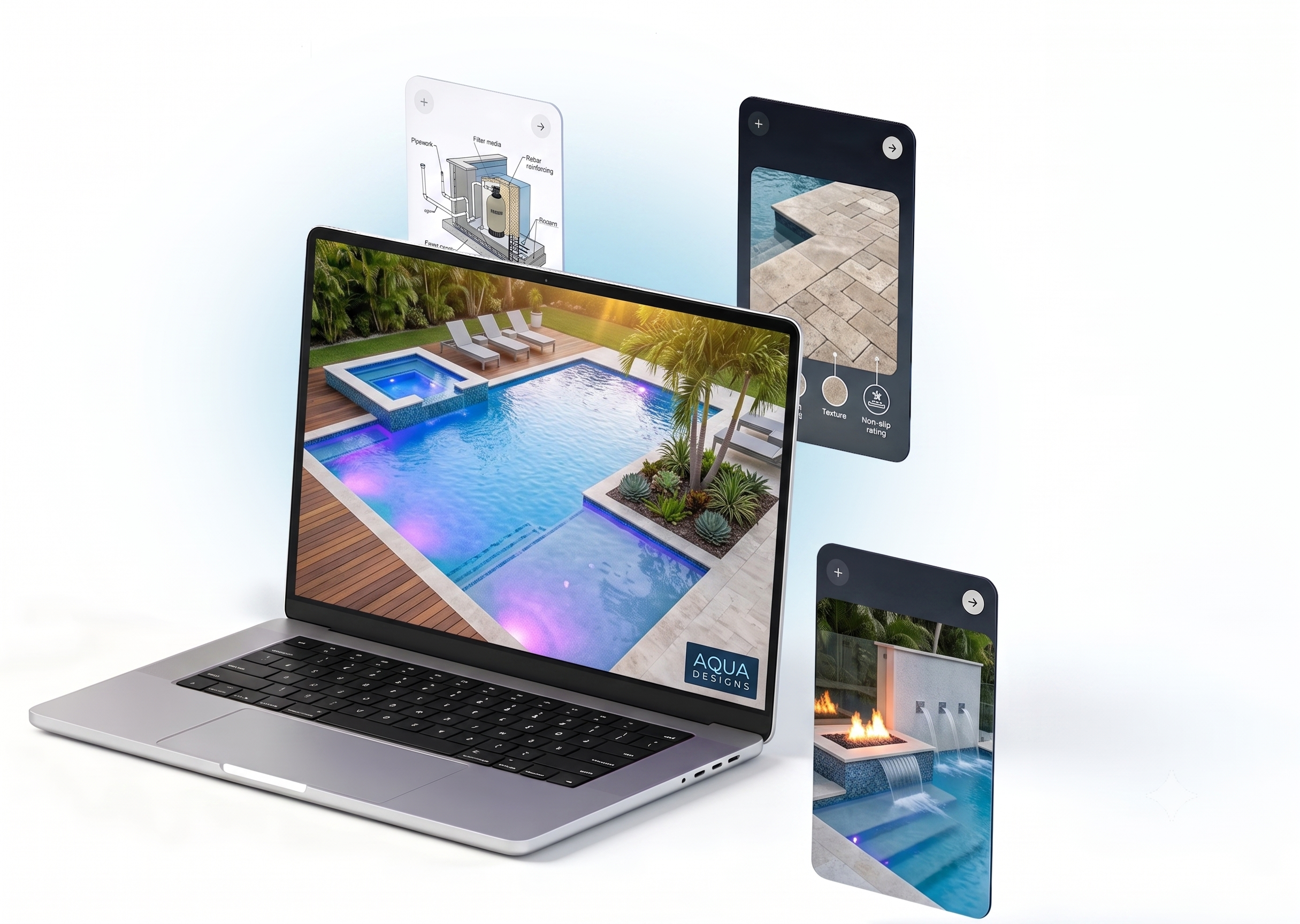



Pool Construction & Restoration Growth Hub
This is the centralized growth hub for pool construction and restoration companies that want predictable revenue.
-
Not random spikes.
-
Not seasonal panic.
-
Not hoping the phone rings.
-
Predictable.
Inside, you’ll find the systems, tools, and frameworks that turn inquiries into design consults… and consults into signed contracts.
Because in pool construction, the difference between surviving and scaling isn’t marketing effort. It’s structure.
Who This Hub Is For
· Close rates swing month to month
· Sales forecasting feels like guessing
· Follow-up depends on individual reps
· High-ticket proposals stall without clarity
This hub shows you how to build that machine.
Resource Overview
Lead
Generation
Companies wanting higher-quality design consults, not just more inquiries
CRM &
Automation
Teams losing deals due to slow response or inconsistent follow-up
Sales & Forecasting
Owners who want clarity on close rates, cost per sale, and predictable revenue
Authority & Buyer Education
Companies that want prospects pre-sold before the design meeting
Not Sure Where to Start?
If growth feels unpredictable, the issue is rarely effort. It is usually a breakdown in:
More ads will not fix that. More reps will not fix that. A tighter system will.
Ready to Build a System That Wins?
Lead Quality, Volume & Predictability
How much do pool construction leads cost?
Pool construction leads typically range from $150 to $600 depending on market competition, targeting precision, and seasonality.
But cost per lead is not the number that matters.
Cost per contract is.
A $500 lead that becomes a $90,000 project is efficient.
A $200 lead that never books a consult is expensive.
When costs feel high, the real issue is usually:
- Slow response times
- Weak qualification
- No structured follow-up after proposals
- Poor visibility into which sources actually close
High-ticket sales demand discipline.
When that discipline exists, acquisition costs stabilize.
What is a good cost per sale for pool builders?
There is no universal cost per sale benchmark specific to pool construction or restoration companies. Acquisition efficiency depends on market competitiveness, margins, growth strategy, and sales execution.
However, broader industry research provides context.
According to The CMO Survey by Deloitte, companies report marketing spending that averages approximately 10–13% of total company revenue, depending on industry and economic conditions.¹ This figure reflects overall marketing investment, not cost per individual sale, but it provides a widely cited benchmark for evaluating customer acquisition spending relative to revenue.
For high-ticket services like custom pool construction, evaluating total acquisition cost in relation to total project revenue is more meaningful than focusing on cost per lead alone.
If acquisition costs are increasing, companies often examine internal conversion factors before increasing marketing spend, including:
- Consult-to-contract close rate
- Proposal follow-up consistency
- Lead qualification standards
- Financing communication
Improving conversion efficiency can materially impact revenue performance without requiring additional advertising investment.
Why do pool companies get inquiries but struggle to close deals?
Pool construction and restoration projects are high-ticket purchases. Homeowners typically research extensively, compare multiple builders, and take time to evaluate pricing, design, and financing options. Because of this, small breakdowns in the sales process can significantly affect close rates.
Common reasons pool companies struggle to convert inquiries into signed contracts include:
- Slow response times after an inquiry is submitted
- No qualification process before scheduling on-site consultations
- Proposals delivered without a structured follow-up plan
- Financing options introduced too late in the conversation
- Limited visibility into where prospects are in the sales pipeline
When follow-up is inconsistent or communication lacks clarity, prospective buyers often delay decisions or move forward with a competitor. In many cases, improving response time, qualification standards, follow-up structure, and pipeline tracking can improve conversion performance without increasing lead volume.
Google Ads vs SEO: which is better for pool builders?
Google Ads and SEO serve different but complementary roles in lead generation.
Google Ads allows pool builders to appear immediately in search results for high-intent keywords such as “custom pool builder near me” or “pool remodel cost.” This channel can generate inquiries quickly and provides more control over lead volume.
Search engine optimization (SEO), by contrast, is a longer-term strategy. It focuses on building organic visibility through service pages, educational content, and local search optimization. Over time, effective SEO can reduce reliance on paid advertising and lower overall cost per lead.
Many pool companies use both strategies:
- Google Ads to generate immediate demand
- SEO to build long-term authority and reduce paid acquisition dependency
The effectiveness of either channel depends not only on traffic generation but also on the company’s ability to convert inquiries into consultations and contracts.
What is a strong close rate for pool consultations?
Close rates for pool construction consultations vary by market, pricing tier, lead source, and qualification standards. There is no universal benchmark that applies to every company.
In many high-ticket home service industries, consultation close rates often fall within a broad range depending on lead quality and sales execution. Lower close rates may indicate:
- Poor lead qualification before appointments
- Misalignment between pricing and customer expectations
- Inconsistent proposal follow-up
- Limited discussion of financing options
- Lack of clear differentiation from competitors
Higher close rates typically reflect:
- Strong pre-qualification processes
- Clear communication of scope and pricing
- Structured follow-up after consultations
- Effective handling of objections and financing conversations
Close rate should always be evaluated alongside cost per sale, average project value, and total marketing investment. Focusing on improving qualification and follow-up processes often has a measurable impact on overall revenue performance.
